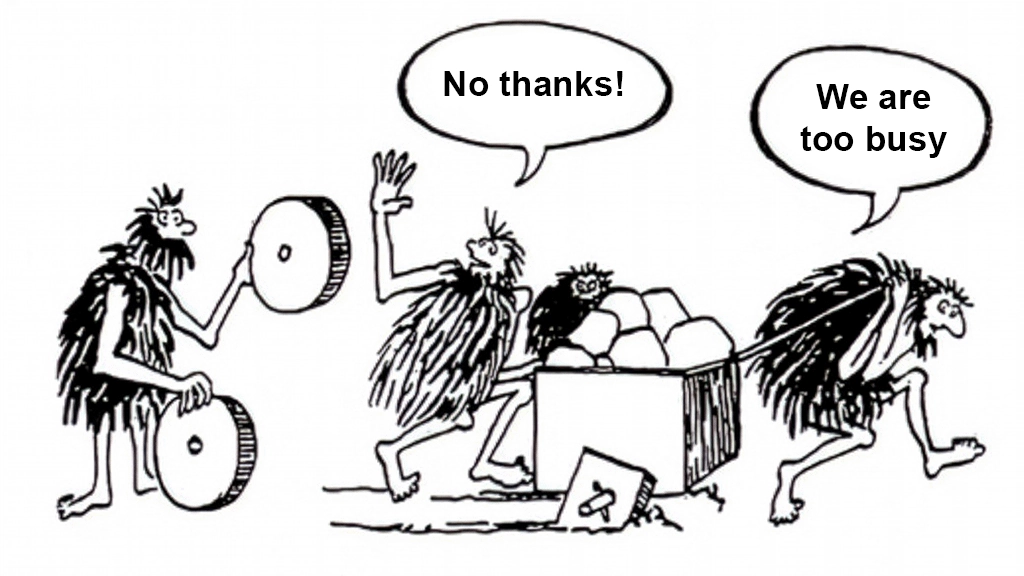
The absurdity is both humorous and painful.
We all know round wheels are better than square ones1. You don’t need a study. You don’t need a 25-page whitepaper. You can look at them and just know.
Unfortunately, we find ourselves in a world that has armed itself against this ideology. Rigidly applying data-driven thinking to every situation is one such weapon, as it ignores the reality that some improvements are plain obvious.
The tiring asymmetry of the data-driven demand
Tell me if you’ve experienced this scenario before:
- You offer: Literally any change, perhaps even the most trivial change anyone has ever suggested.
- You receive: An interrogation.
Where’s the data? What’s the ROI? Prove it will be better. Show the metrics. List the risks.
Are we really okay with wasting all this time, debating the merits of obvious improvements? Meanwhile, the status quo remains untouchable. No questions. No proof required.
Square wheels? That’s just how we’ve always done it. They’ve gotten us this far, why do we need different wheels now?
Nobody has to prove they work. Nobody has to show any data. The burden lands squarely on the shoulders of those who dare to suggest something better.
We need to call this what it is: institutional cowardice masquerading as rigor.
The cost of proof versus the cost of trying
Let’s do some actual reasoning here.
I could write an extensive mathematical proof in support of round wheels. Gather data. Model the physics. Derive Pi. List every edge case. Make a fancy spreadsheet with charts and graphs. Describe all the scenarios in which round wheels are not, in fact, a good fit. When I’m done, all this effort will have been… for what, exactly? Engaging with bad-faith arguments from people who have already decided they never wanted change in the first place?
Or, we could try the round wheels today and see results by lunch. Which is more scientific? Writing proofs in a vacuum, or running an experiment and seeing what happens?
Demanding endless proof stalls decisions. It’s a way to say no without ever having to defend it. It’s a way to run out the clock until the proposal dies of exhaustion.
Intuition is not a dirty word
Some people think any decision without data is illegitimate. They’re wrong.
Intuition exists for a reason. It reflects years of experience, compressed into a feeling. When an expert says, “This is obviously better,” they’re drawing on years of pattern recognition, not random guessing. Of course, intuition has its limits and we shouldn’t rely on it in every context, but dismissing it altogether overlooks the value of accumulated knowledge and judgment.
We don’t need to measure everything to establish a baseline of truth. I don’t need a peer-reviewed study to demonstrate that fire is hot. I don’t need a controlled trial to know that stepping on a nail hurts. Some things are just evident.
Data has its place
That place is genuine uncertainty. When reasonable people could disagree. When the costs are high and the path is unclear. Not performative uncertainty deployed to slow things down. If you actually can’t tell whether the round wheels are better, we have a different problem, and a dataset on the wheels in question isn’t going to fix it.
If you want to block a change, fine. Justify your “no” with the same rigor. Show the data for square wheels. Prove that the status quo is best. But you won’t, and you can’t, because you never had to. Why should the status quo get a free pass, but the improvement has to pay rent?
A simple heuristic
If trying something is cheap and the improvement is obvious, just do it.
Don’t ask for permission. Don’t write a proposal. Don’t schedule a meeting. Just do the thing. The people who wanted proof will be fine once they see it work. If it fails, you lose a day, not a quarter. Only expensive, irreversible, or truly unclear changes need endless analysis. Obvious, cheap improvements like round wheels aren’t any of those things.
The bottom line
The endless pursuit of becoming “data-driven” can be abused as a shield for people who are afraid to make decisions. It sounds good on paper. Hell, it even sounds rigorous. But in practice, it often means “I am paralyzed by fear, so I’m hiding behind process until this goes away.”
Real data-driven thinking would notice when there is zero data supporting the current approach. Real rigor would apply skepticism evenly, not just to new ideas. Real rationality would weigh the cost of gathering data against the cost of experimentation.
The process hostages have Stockholm syndrome so bad, they think the grinding sound of the square wheels means they’re making progress. I’m tired of dragging around these square-wheeled carts. Aren’t you?
Just do it. Try the round wheels already.
You can always measure the improvement afterwards, assuming you have any energy left after justifying why you needed to try them in the first place.
In the idiomatic sense. Of course, there are an infinitesmally small number of circumstances in which square wheels are useful. ↩︎